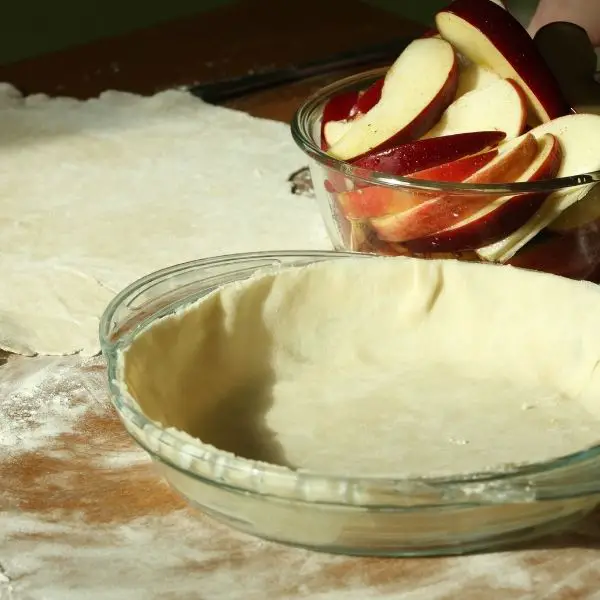
Easy, Homemade Pie Crust with Vinegar
This easy, homemade pie crust is flaky and tender. For any type of pie, sweet or savory, this pie crust recipe is sure to please. It's a recipe from my grandmother with my own special tweak.
Print
Pin
Servings: 1 crust
Calories: 1235kcal
Ingredients
- 1 ¼ Cups unbleached all-purpose flour
- ¼ tsp real salt
- 3 Tbs solid coconut oil
- 3 Tbs unsalted cold butter
- 1 tsp raw, organic apple cider vinegar
- 3 Tbs cold water
Instructions
- In a medium bowl, mix flour and salt together
- Using a pastry blender, cut in butter and coconut oil until the flour mixture resembles coarse crumbs. If you use a mixer or food processor, be sure not to over process.
- Add the apple cider vinegar and mix in thoroughly. Now carefully add the water 1 tablespoon at a time until a ball of dough forms - you don't want it to be sticky.
- Set the dough ball in the refrigerator for 15 minutes. This allows the butter to rechill.
- Using a rolling pin, roll out the dough on a generously floured surface until it's a few inches larger than your pie plate - 4-5 inches larger is a good goal. You may have to flip the crust to re-flour your surface and the crust to prevent it sticking to the surface and your rolling pin.
- Once you have your pie crust rolled out, lightly flour the top of it and carefully roll it up, loosely, or fold it into quarters. Then gently lift it and unroll it into your pie plate.
- Gently flute (fold the excess dough under itself) even with the pan. Now you can crimp the edges with your fingers or use a fork to mark the edge.
Single Crust for Filled Pie
If you want a crust for a pie filling that doesn't have to be baked, like Ma Horton's Velvety Chocolate Pie, you're now ready to bake the crust.
- Heat the oven to 425 degrees.
- While the oven is heating, prick the bottom and sides of your crust generously with a fork (see the last photo above). This will prevent the crust from rising in the middle, causing cracks or peaks and valleys in your crust.You can also prevent cracks or peaks and valleys by laying a piece of parchment paper on top of your crust and placing baking beads or dry beans on the paper when baking the crust.
- Bake the pie crust for 10 minutes, until your crust is golden brown or to your desired brownness.
Single Crust For Baked Filled Pie
If you want a pie crust for a pie that will be filled and then baked, like Old-Fashioned Coconut Cream Pie,
- Follow steps 1-7 then set the pie crust in the refrigerator while you prepare the filling.
- When the filling is done, remove the pie crust from the fridge and pour it into the pie pan.
- Bake as directed in your recipe.
Double Crust Pie
- For a pie with two crusts, like apple pie, simply double the recipe.
- Follow steps 1-4 above then,
- Divide the dough in half and roll out each crust as above in steps 5-7.
- Put both crusts in the refrigerator while you prepare the filling.
- When the filling is ready, remove the crusts from the fridge, fill, place the top crust on, and vent.
- Proceed according to your recipe.
Nutrition
Nutrition Facts
Easy, Homemade Pie Crust with Vinegar
Amount per Serving
Calories
1235
Calories from Fat 702
% Daily Value*
Fat
78
g
120
%
Saturated Fat
58
g
363
%
Trans Fat
1
g
Polyunsaturated Fat
3
g
Monounsaturated Fat
11
g
Cholesterol
90
mg
30
%
Sodium
887
mg
39
%
Potassium
188
mg
5
%
Carbohydrates
119
g
40
%
Fiber
4
g
17
%
Sugar
1
g
1
%
Protein
17
g
34
%
Vitamin A
1053
IU
21
%
Calcium
36
mg
4
%
Iron
7
mg
39
%
* Percent Daily Values are based on a 2000 calorie diet.